How to put together a funeral Order of Service.
The Order of Service is the booklet that everyone attending the funeral gets so that they can follow along in the service. Whether that’s hymns where they need to sing along, extracts from the readings, or to introduce who is speaking and their relationship to the deceased. Usually, the Order of Service is printed and becomes a keep-sake for everyone in the audience to take home and remember the day and the life of the person they’ve lost.
What is the basic structure of an Order of Service?
Regardless of the type of ceremony you are organising, there is a basic structure that you can follow. You can then adapt this for the type of ceremony and the level of personalisation you are looking for.
Title page
There may be some music as the coffin is brought into the service and this should also be referenced inside the Order of Service.
Welcome / Opening words
Music or moment of reflection
Readings or tributes
Main address / eulogy
Closing words
Final music or farewell
Let’s go through each of these elements one by one to give you some inspiration.
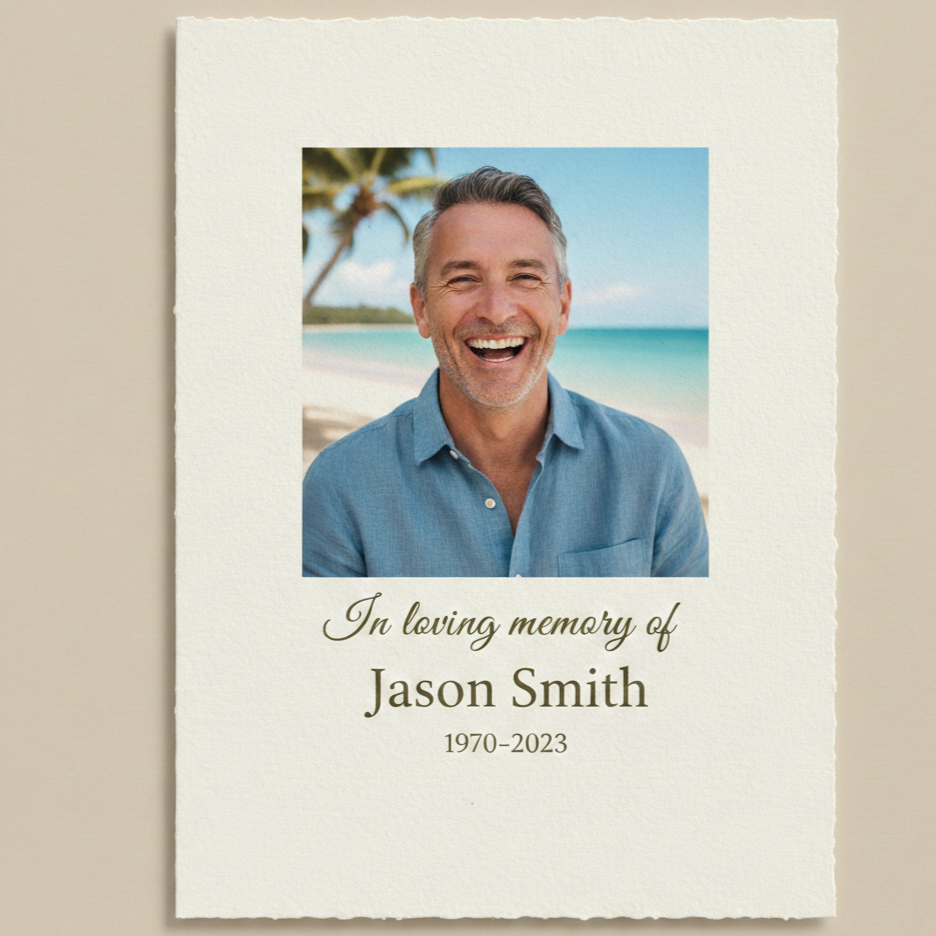
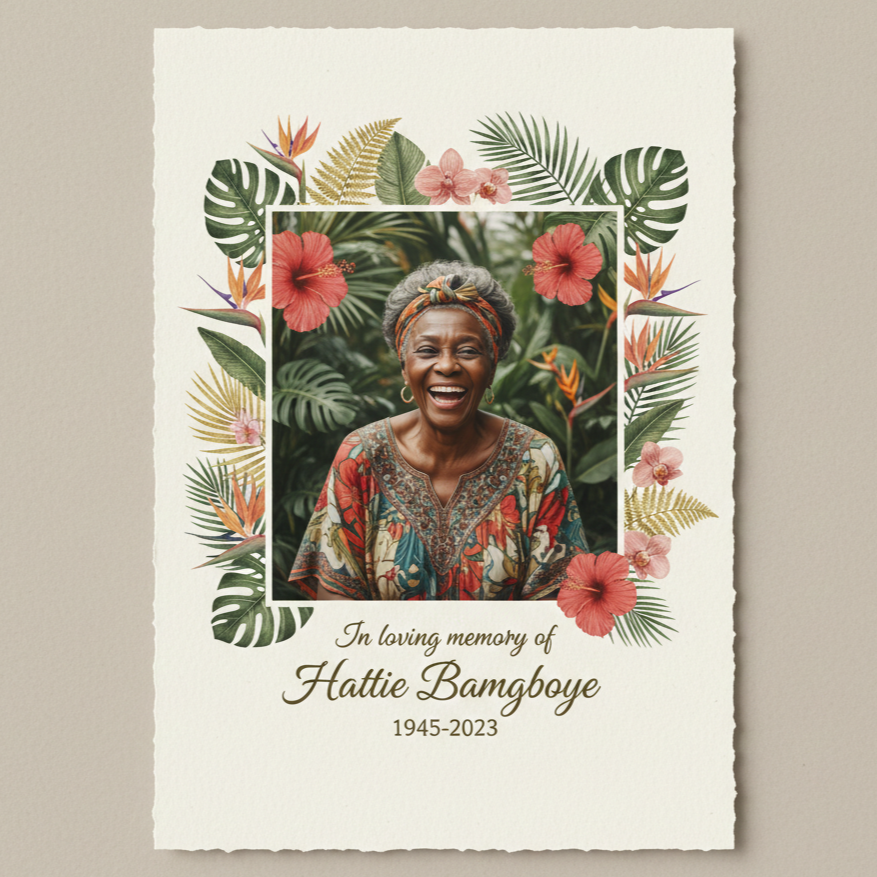
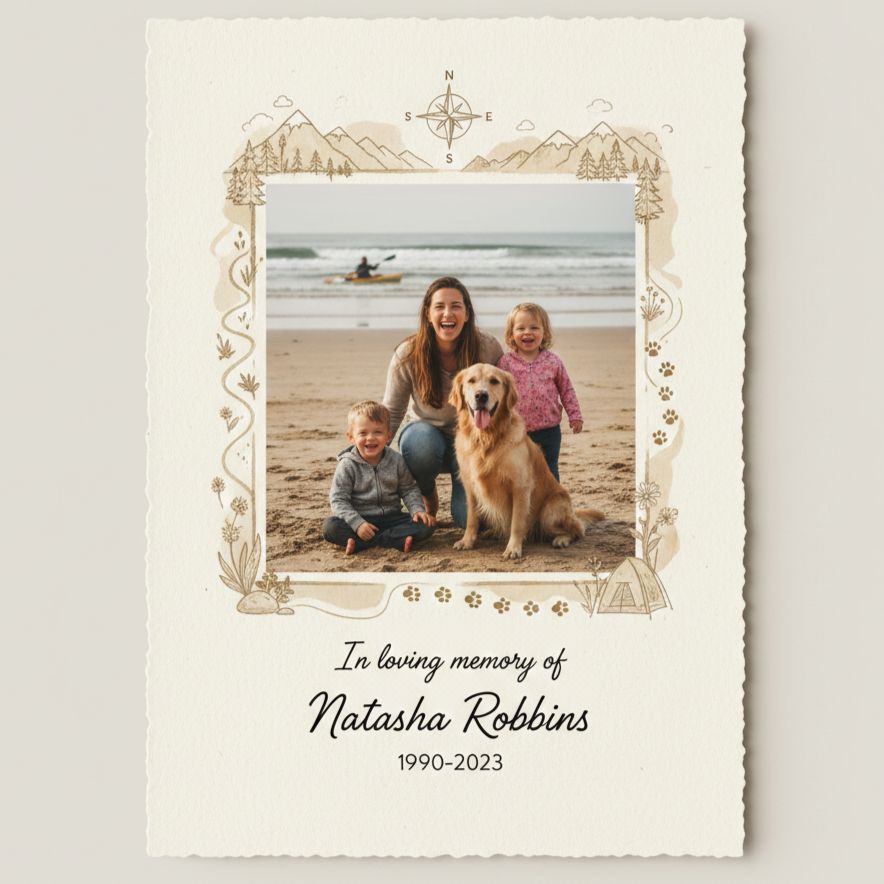
The title page for an Order of Service.
Important things to include in the title page of an Order of Service:
A photo where the person looks happy and healthy, you want everyone to remember them at their best.
Usually the words ‘In loving memory of (name)’
The year of their birth and death
You could try using an AI tool for decorative elements appropriate to the person, such as their hobbies, football team, or things they loved.
Here are some examples:

What music should I use for a funeral service and do I need to include it in the Order of Service?
Music is a great tool to help everyone to reflect, to have time to be within their thoughts and listen, and also to provoke happy memories of the deceased.
Here are a couple of tips for choosing the music and how to incorporate music into your Order of Service.
-> If you’re going for hymns or music that the congregation should sing along too then you should definitely print the words in the Order of Service.
-> Regardless of whether you are going for hymns, instrumental pieces, or well-known songs, you should print the name of the song, artist and recording you are using in the Order of Service. This way if people want to go home and re-listen to any of the music on their own they know what to look for.
-> If you are struggling to choose appropriate music try to visualise the ceremony and how you want people to feel at various moments. For example, when the coffin is brought in you may want a slower instrumental piece to allow everyone to process the moment, where’s after the Eulogy you might want some more uplifting music that recalls specific memories .
-> The music should be reflective of the deceased. One way to think about it is ’if they were to be on Desert Island Discs, what music would they choose?’ Moments from events, holidays, things they sang along to in the car, songs you danced to together, or songs with lyrics that are representative of their attitude towards life.
Here is a list of some of the top songs used at funerals in the UK according to research by Sunlife.
| Rank | Top 10 Songs Played at Funerals | Top 10 Songs We Want for Our Own Funeral |
|---|---|---|
| 1 | Abide with Me | My Way – Frank Sinatra |
| 2 | Amazing Grace | Angels – Robbie Williams |
| 3 | My Way – Frank Sinatra | Jerusalem |
| 4 | All Things Bright and Beautiful | Abide with Me |
| 5 | The Lord Is My Shepherd | You'll Never Walk Alone – Gerry and the Pacemakers |
| 6 | Angels – Robbie Williams | Always Look on the Bright Side of Life – Monty Python |
| 7 | Goodbye’s (The Saddest Word) – Celine Dion | Amazing Grace |
| 8 | Over the Rainbow – Judy Garland | Time to Say Goodbye – Sarah Brightman & Andrea Bocelli |
| 9 | You’ll Never Walk Alone – Gerry and the Pacemakers | Wind Beneath My Wings – Bette Midler |
| 10 | Jerusalem | Spirit in the Sky – Norman Greenbaum |
How do I choose the readings for a funeral Order of Service?
This will depend a lot on the type of ceremony you choose eg. religious versus secular, and to an extent the age of the person you are mourning. Here are some tips for choosing the readings:
-> Overall, the ceremony is both a celebration of the life of the deceased, and a point of closure for the attendees - a chance for them to say goodbye and seek comfort in being around people who also loved the person who has died. The readings should be a mix of reflecting how the person approached life and reflective moments where the audience can take comfort in the words.
Here’s two non-biblical examples:
| A funeral poem to remember how they approached life | A poem that offes comfort to the congregation |
|---|---|
|
Remember me when the room is full and the music is loud, Remember me in the moments of laughter, Remember me, too, in the quieter moments — I lived my life with my heart open. If you remember me, don’t do it with sadness alone. Carry me forward in the way you live: And when you think of me — |
He / She Is Gone You can shed tears that she is gone, You can close your eyes and pray that she will come back, Your heart can be empty because you can’t see her, You can turn your back on tomorrow and live yesterday, You can remember her and only that she is gone, You can cry and close your mind, be empty and turn your back, — David Harkins |
The role of the Eulogy in the Order of Service
It’s not necessary to print the whole Eulogy in the Order of Service. Just the name of the person giving it and maybe a sentence or two about their relationship to the deceased.
Eulogy FAQ:
Who do I ask to give a Eulogy at the funeral?
Usually, it’s someone close to the deceased but not an immediate family member (for emotional reasons) but that doesn’t mean that if an immediate family member wants to speak they shouldn’t. Choose someone comfortable speaking in front of a group of people, who is able to help the congregation recall fond memories and celebrate the life of the person who has died.
Tips for how to go about writing a Eulogy
Sum up their character in your own words.
Try to avoid giving their whole life story but sketch key details and achievements.
Ask friends and family for funny or moving anecdotes.
Remember some of their good deeds and when they were there for family or members of the community.
Reference the hole they will leave and the gap that will need to be filled by family and friends to support each other through the period of grief.
How long should a Eulogy be?
This is completely up to the person giving the eulogy and the organisers of the funeral. It also depends if there is only one person giving a eulogy or multiple people. It is usually 5-10 minutes long. Any longer than 10 minutes can make the audience a little restless, too short can be too brief as this is one of the most personal parts of the ceremony, completely tailored to the life of the person that has passed.
What if I cry during the Eulogy?
It’s normal to get emotional when giving the eulogy. Be generous to yourself and have a plan. Give yourself a moment, take a deep breath and count to five, then get back on track and keep going.
How to personalise a funeral Order of Service
A funeral order of service doesn’t need to be completely sombre, there should be a joyful element of celebration and elements characteristic of the deceased’s personality. Here are some examples of things you can include, even if they aren’t necessarily read out in the ceremony:
Does the person have a favourite cocktail recipe you could include? …And serve at the bar later on.
A photo page with a collage of key memories.
A piece of art of writing that they did themselves. Even if it’s a photocopy of a hand-written note.
A snippet from a school report that describes their character or an achievement.
A few quotes from friends of what they remember best of the person they love.
A hand-drawn map of places they lived.
A list of their favourite things eg. fresh powder skiing, an 18-hole golf course, New York cheesecake, South African wine, chocolate labradors, etc.
If you are looking for guidance for other elements of planning a funeral, take a look at some of our articles below.

Putting together an Order of Service can be daunting. This guide takes you through the key elements, such as the readings and music, how to select them, and ways to personalise both the service and the booklet so that it becomes a memorable keep-sake for all who attend.